
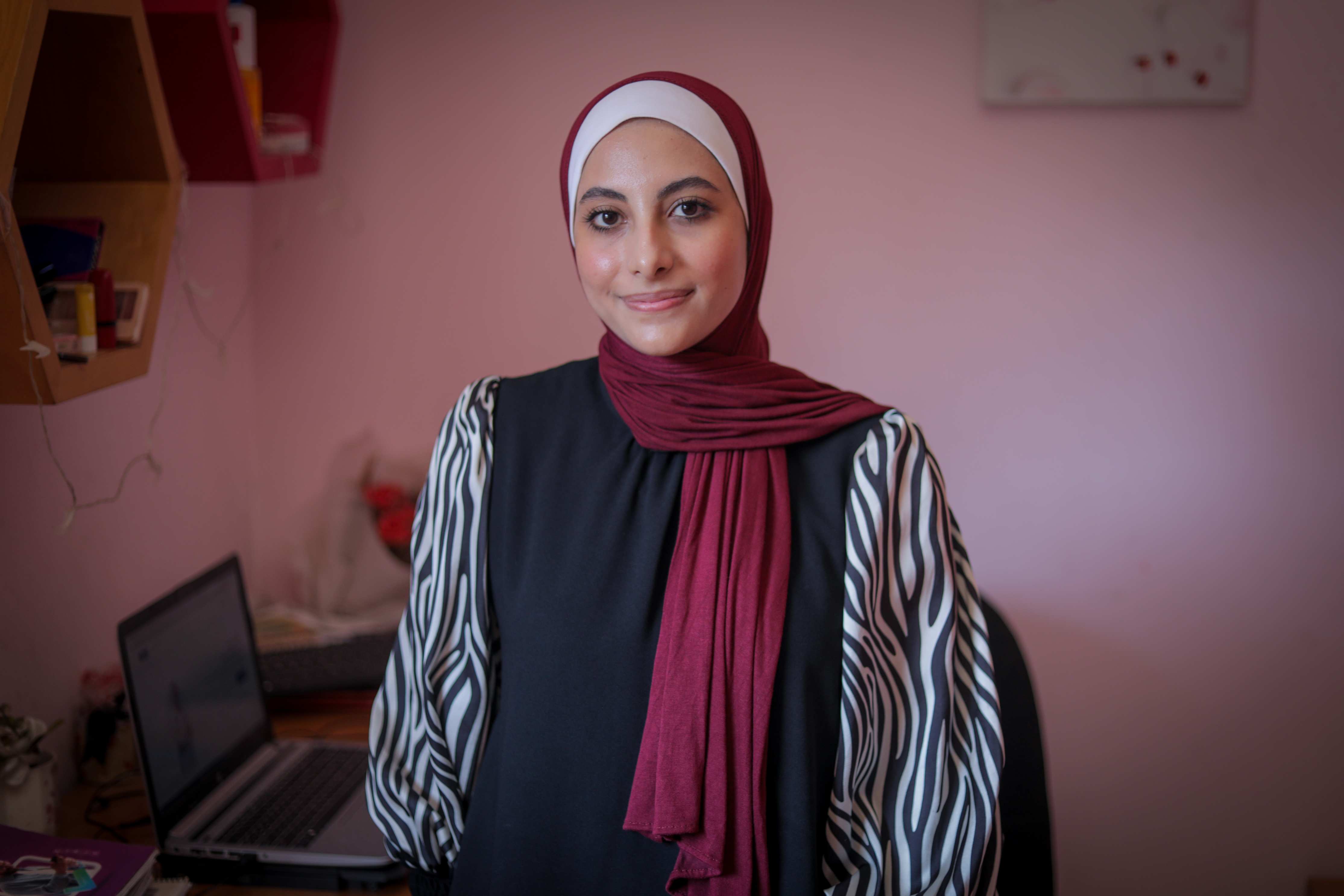
Rawan Hossam Qaoud had gone looking for an internet connection.
She had an online meeting with a technology specialist outside Gaza who had agreed to help her develop an idea she had been carrying through months of war and displacement. But where she was staying in Nuseirat, the connection was too weak and her ageing device made the call almost impossible.
So Qaoud left the place where she was sheltering and searched for somewhere she could get online.
Eventually, she found a connection. The meeting began. For a while, it went well.
Then, towards the end of the call, the situation around her changed. Qaoud says the area was surrounded and strikes began nearby. She ran.
“I survived by a miracle,” she says.
She did not get another opportunity to continue those conversations with technical specialists for some time. But she did not abandon the project.
For Qaoud, now 23, the idea she had been trying to explain that day was not born from a startup workshop or a search for the next promising technology product. It began with a relative who was ill.
He had a chronic condition and needed a particular medicine. Qaoud and her family searched for it, moving from place to place, but could not find it in time. His condition deteriorated and, Qaoud says, he died after the delay in receiving treatment.
Later, the family discovered something that has stayed with her: the medicine had been available at a pharmacy nearby.
“How many other people might go through the same experience simply because they don’t know where the service or the medicine is?” she remembers thinking.
That question became MedLink.
When finding care becomes part of the illness
For patients in Gaza, the problem MedLink is trying to address has become increasingly urgent.
By July 2026, only 44% of the health service points mapped in Gaza before October 2023 were functioning, according to UN humanitarian reporting. Services for an estimated 350,000 people living with chronic diseases remained severely disrupted, with shortages affecting medicines and equipment for conditions including diabetes, hypertension, kidney disease, cancer and cardiovascular illness.
For someone who depends on regular medication, the consequences of that disruption can be measured not only in what is unavailable, but in the time and physical effort spent discovering what remains.
A clinic may have closed or moved. A patient’s paper medical record may have disappeared during displacement. A medicine once routinely stocked may require visits to several pharmacies before it can be found – if it can be found at all.
Qaoud describes the change this way: before the war, accessing healthcare could be slow and frustrating. Now there is another question that comes first.
Is the service still there?
“The problem moved from ‘How do I reach the service faster?’ to ‘Does the service still exist at all?’” she says.
MedLink is her attempt to answer that question before the patient leaves home.
The name combines “medical” and “link”: a connection between patient, doctor, clinic and pharmacy. The ambition is to bring what are usually fragmented stages of healthcare into one digital journey.
A patient searches for a doctor or clinic and books an appointment. After the consultation, the doctor can create an electronic prescription that remains in the patient’s digital record. The patient can then search for the prescribed medicines and identify pharmacies where they are available instead of travelling from one pharmacy to another.
Qaoud also wants the platform to make the physical journey easier. Medicine delivery and patient transport can be requested through the system, particularly for older people and people with disabilities who may struggle to reach clinics or pharmacies.
She gives the example of an older woman with limited mobility who needs regular medical appointments.
Without such a system, Qaoud says, the woman may first have to find someone who can transport her, then wait at a clinic while staff work through manual records, and finally leave carrying a paper prescription and begin another search for a pharmacy stocking the medicine.
MedLink is intended to turn that into one connected process: arrange the appointment and transport, receive the prescription digitally, find the medicine and, where possible, have it brought home.
It is an ambitious proposition for a place where digital infrastructure itself has been repeatedly damaged.
The World Bank estimated that about 85% of Gaza’s telecommunications infrastructure had been destroyed by late 2024. OCHA continued to document internet blackouts and damage to telecommunications infrastructure in 2025, alongside the electricity and fuel shortages needed to keep networks operating.
For Qaoud, those are not abstract design constraints. They have shaped how she works – and how she wants MedLink eventually to work.
She plans to add an offline-first system, allowing information to be saved on a user's device and synchronised once connectivity returns, with SMS providing another route for people without reliable internet or newer smartphones. An emergency QR record is also planned, giving medical staff quick access to essential information such as chronic conditions and blood type.
These features are still being developed. But the logic behind them is central to her idea: a healthcare platform for Gaza cannot be designed on the assumption that electricity, internet access or even a patient’s location will remain stable.
Building while being displaced
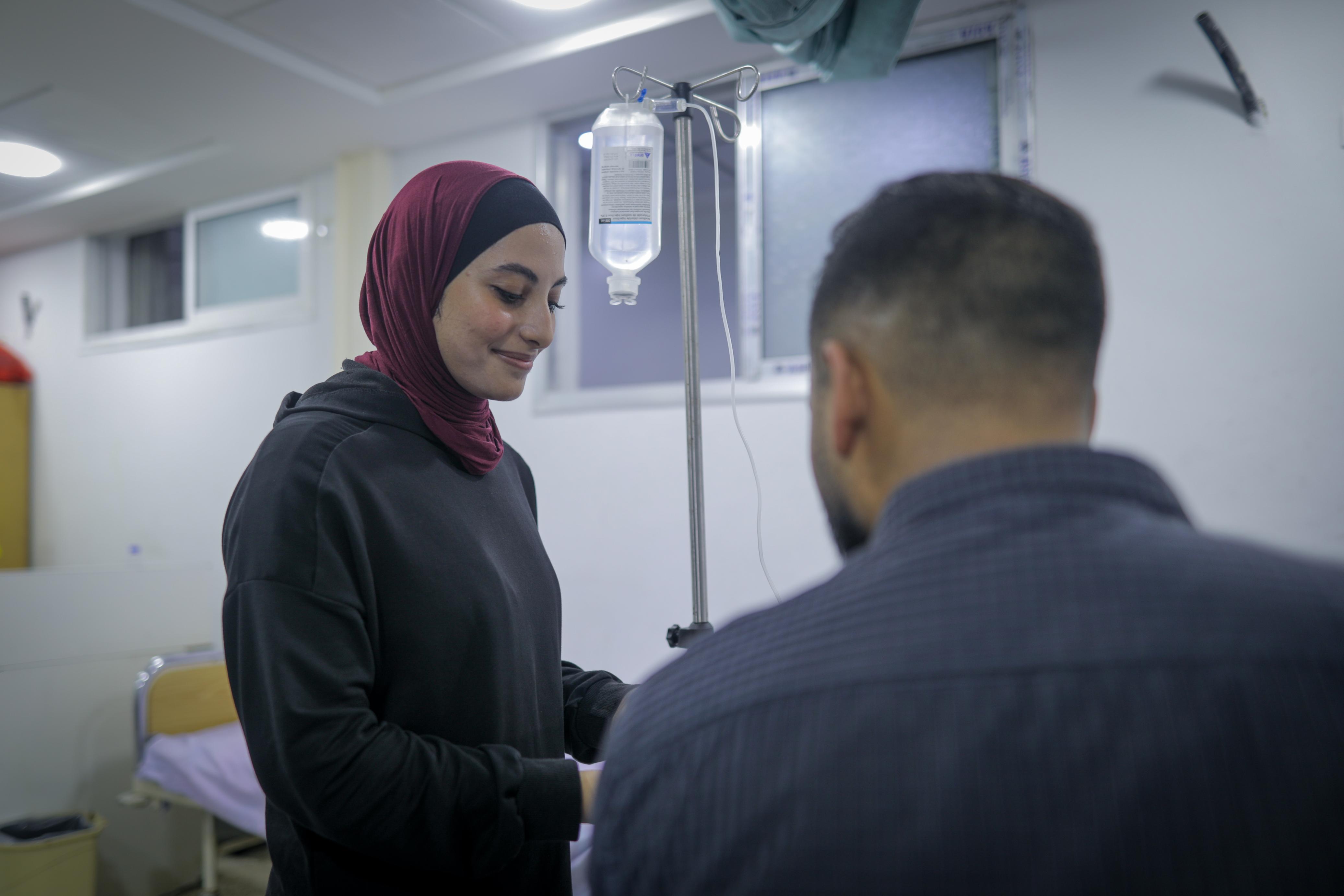
Qaoud grew up in Sheikh Radwan, Gaza City, where she is now living again in her family’s partially damaged home.
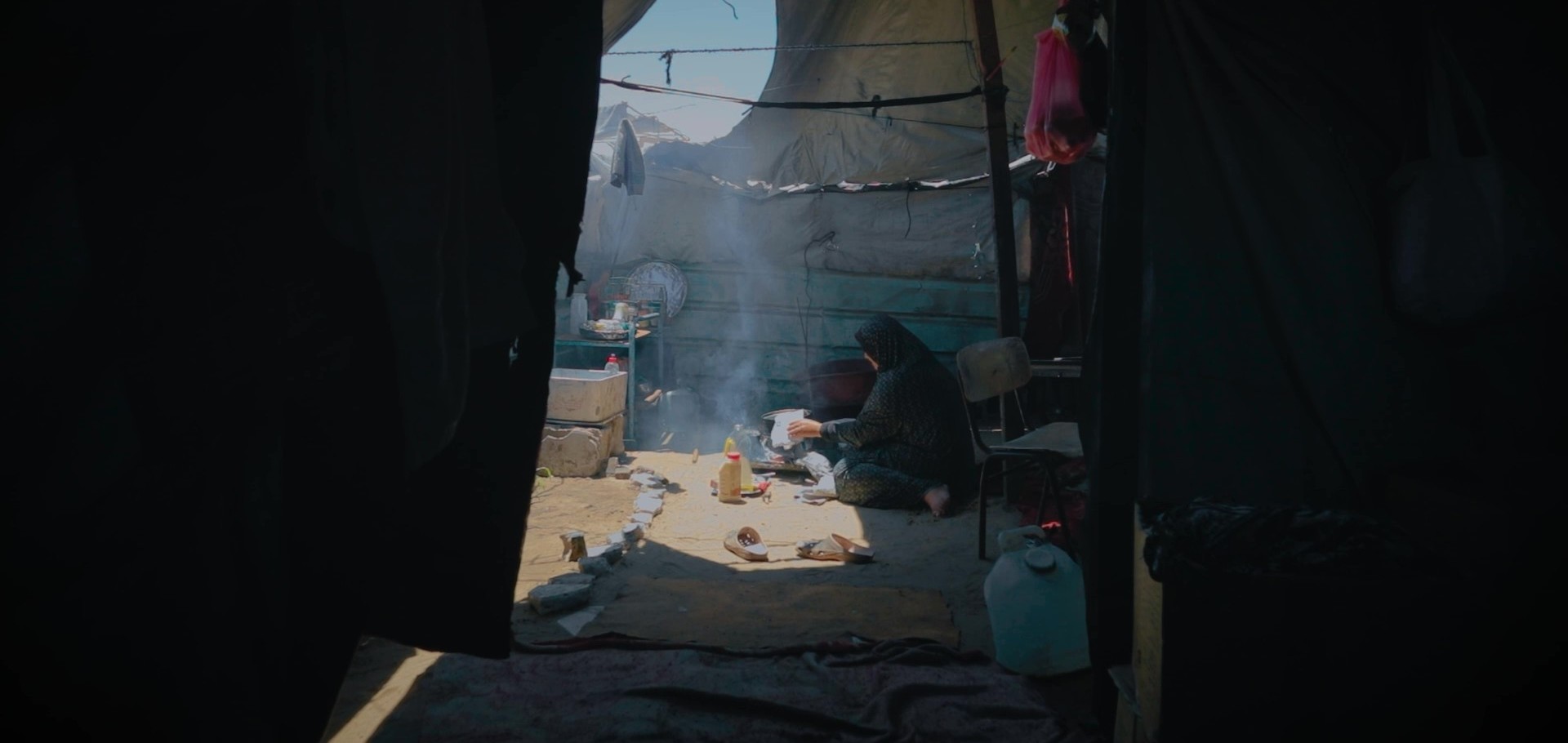
She was still a university student when the war began. Over the years that followed, she says she was displaced five times, moving between Gaza City, Nuseirat and Deir al-Balah, sometimes living in a room and at one point in a deteriorating tent.
Her university was destroyed, she says, and for roughly 11 months she had no reliable access to a phone or computer suitable for work and no dependable internet connection. Across Gaza, the destruction of higher education has been sweeping: a UNESCO assessment published in late 2025 found that 95% of higher-education campuses had been damaged, including 22 of the 38 assessed campuses that were completely destroyed.
When Qaoud returned from one period of displacement in 2025, electricity and internet remained unavailable in her area. She would walk long distances to reach workspaces where she could connect.
Paying to sit there for hours was often beyond her means.
So she developed another routine: go to the workspace, download the videos, books and files she needed, then return home and work through them offline.
At displacement sites, she also taught English to children for free.
It was one way, she says, of insisting that education continue even when almost everything around it had been interrupted.
On 9 July 2026, after all of that disruption, Qaoud graduated in Computer Systems Engineering from Al-Azhar University.
She did not arrive at MedLink without technical experience. Before the war, she worked as a front-end developer, translating UX and UI designs into responsive webpages. She also gained experience in business analysis, learning how to collect users’ requirements and turn them into specifications for technical teams, and later trained in full-stack development using React, Laravel and MySQL.
Those experiences gradually changed what she wanted from a career in technology.
“I realised I didn’t only want to be a developer,” she says. “I wanted to understand the problem, the market and the user, and build the solution from the beginning.”
Technology appealed to her, she says, because it could transform “a problem into a real solution people can use”.
Not a finished product – yet
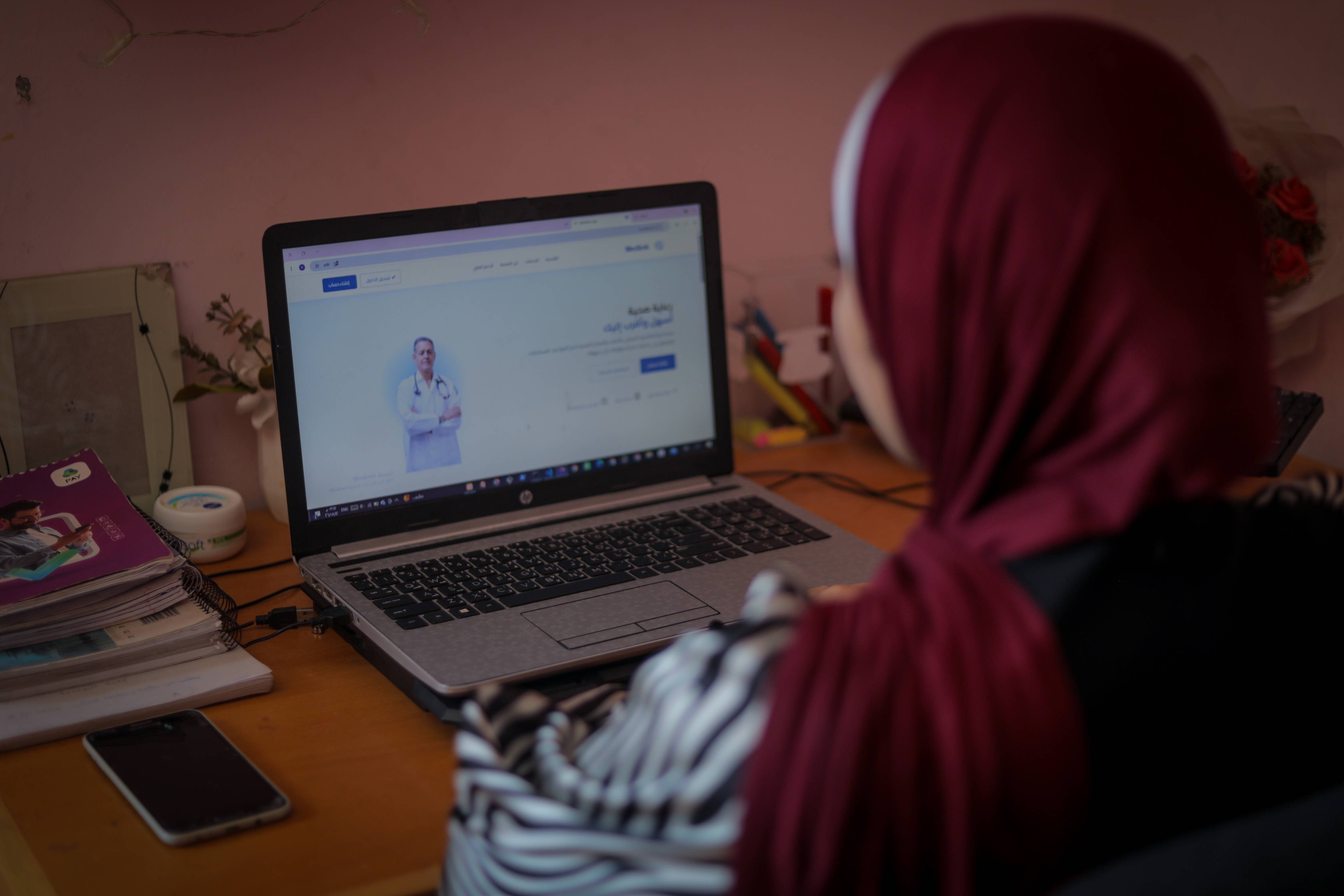
MedLink is no longer simply an idea, but neither is it yet a live healthcare network.
Qaoud has built a working minimum viable product, or MVP. The core workflows include electronic appointment booking, digital prescriptions and patient records, a pharmacy medicine-search function, integrated payments and the ability to request medicine delivery or transport to a clinic.
The final user interface, offline capabilities, emergency QR record and interactive emergency-pharmacy features still need further development.
And one critical test remains: actual patients.
Qaoud has not yet run a formal field trial. Her next goal is deliberately small: three or four clinics, two or three pharmacies and between 10 and 15 patients. She wants to see whether at least 80% can successfully complete the platform’s basic tasks before expanding.
She has already approached nine clinics and pharmacies in her area, she says, and received interest in a system that could help organise appointments and medicine stocks.
That willingness to start smaller is, in part, something she attributes to Gaza Stars.
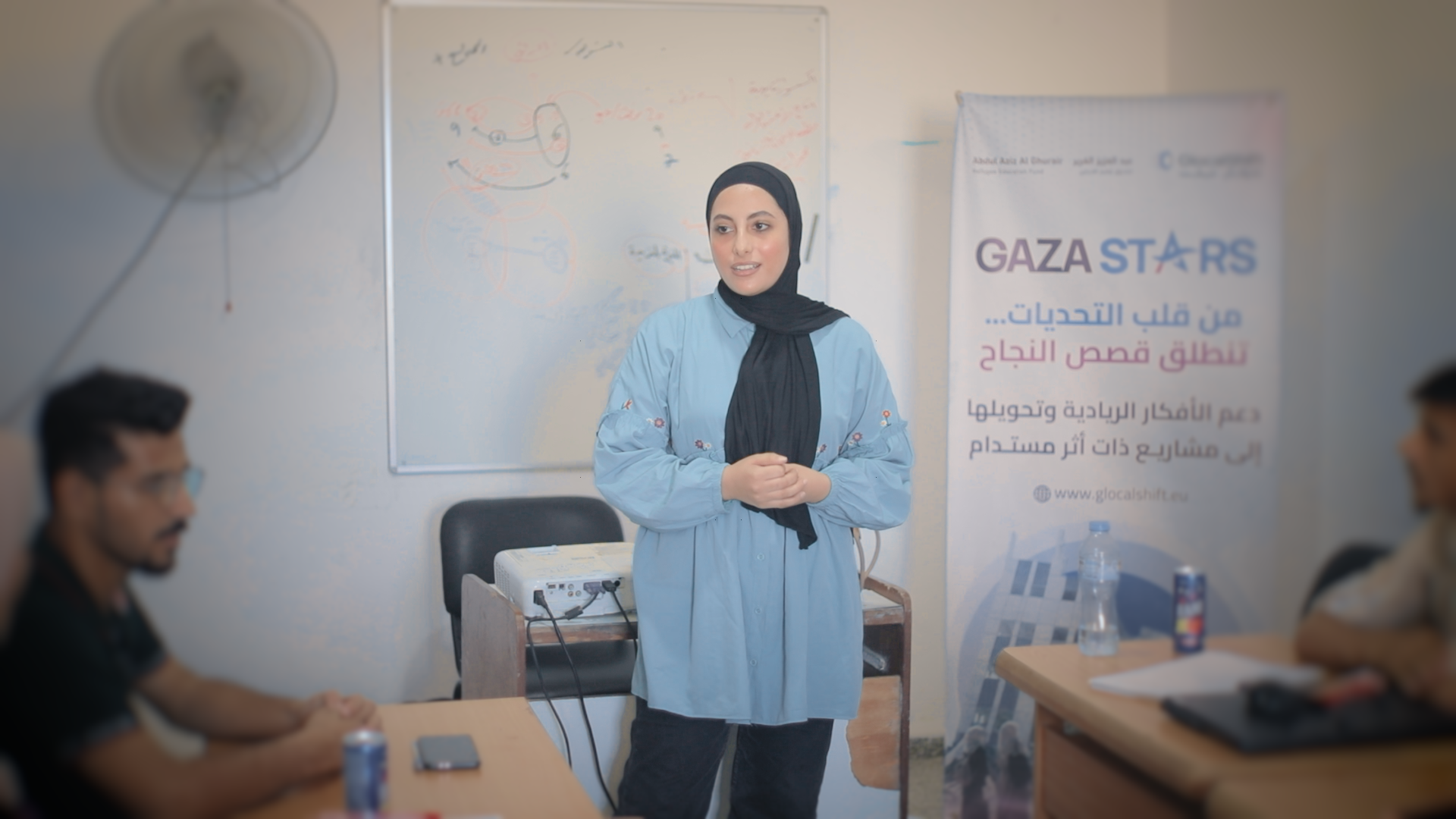
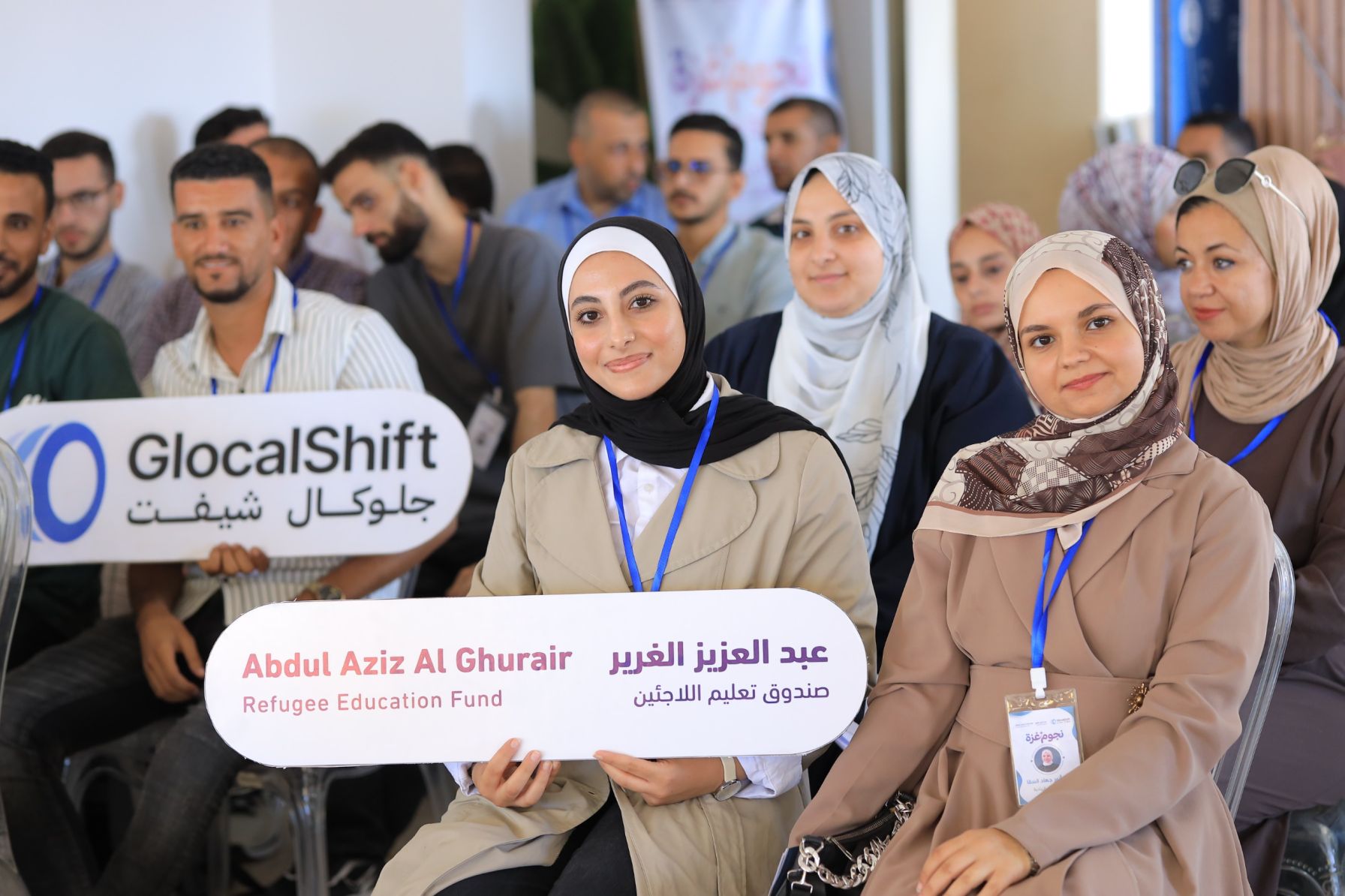
The six-month entrepreneurship programme, run by GlocalShift through its Learning to Earning initiative in strategic partnership with the Abdulaziz Al Ghurair Refugee Education Fund, is supporting 300 young entrepreneurs in Gaza with training, mentorship, pitching and access to seed funding.
Qaoud joined its entrepreneurship track after seeing an advertisement on Facebook.
Before the training, she says, her instinct was to describe her market simply as “all patients in Gaza”.
The programme forced her to be more precise.
Through sessions on human-centred design, market research, business models and pitching, she began with a narrower group: older people, patients with chronic illnesses and people with disabilities – those, she argues, who pay the highest price when a fragmented health system fails.
“A strong idea on its own isn’t enough,” she says. “It has to be built on real evidence, not assumptions.”
Her business model reflects the same thinking. Qaoud does not want patients to pay for the platform’s core functions. Instead, she envisages modest monthly subscriptions from participating clinics and pharmacies, alongside a small commission on transport and medicine-delivery services.
The aim, she says, is to remove a financial barrier for patients while eventually making MedLink financially independent rather than permanently dependent on aid or grants.
If she secures funding, the first money would go towards bringing a front-end developer and UI/UX designer into the project, completing the technology and beginning real-world testing.
Her target is to reach a first market launch within three months: develop in month one, test with a small group in month two, improve the product and seek the first paying institutional customers in month three.
For a conventional startup, three months might sound like a product-development timetable.
For Qaoud, time has acquired another meaning.
It is the time a patient spends looking for medicine. The time lost travelling to a pharmacy only to discover the drug is unavailable. The time between a prescription being written and treatment beginning.
It is also the time she herself has lost to displacement, blackouts and unreliable internet – and the time she has repeatedly found ways to reclaim.
Her ambition for MedLink is eventually much larger: a network connecting clinics, pharmacies, laboratories and patients across Gaza, before potentially expanding to the West Bank and beyond.
But she returns to the patient when she describes what success would mean.
She imagines someone with a chronic disease receiving a warning before their medicine runs out. An older woman knowing where her doctor has moved rather than travelling from clinic to clinic. A displaced patient carrying years of medical information digitally, even if the paper documents – or the home in which they were kept – are gone.
After five displacements of her own, it is not difficult to understand why continuity matters to her.
In five years, Qaoud says, she does not want MedLink to be remembered simply as an app for booking appointments.
“This is not a technology project,” she says. “It is a promise that no patient is left alone on their journey towards recovery.”

.jpg)
.jpeg)
