
When he enrolled in a nursing programme in Gaza, it felt like the right call. In a region where the healthcare system had been under strain for decades, nursing offered a clear route into a profession that genuinely mattered. He was diligent, performed well, and had every reason to continue. But as the semesters passed, something did not sit right. He was exceeding expectations without much effort and began to wonder whether he was simply aiming too low.
After five semesters, Mohammad Al-Jadili made a decision that most people around him would have considered risky. He left nursing and enrolled as a first-year medical student at Zagazig University in Egypt, starting from scratch. It meant accepting delay, financial pressure, and a much longer road. But Mohammad had decided that his ambition was worth the cost of beginning again.
By the time he reached his final year, that decision had been vindicated. He graduated with a grade point average of 3.87 out of 4, earning High Distinction and First Class Honours. He had rebuilt his academic life from zero and come out at the top. What he could not have prepared for was what came next.
The World He Left Behind
To understand what Mohammad has been carrying, it helps to understand where he comes from.
Gaza's health system was already one of the most fragile in the world before the war escalated in late 2023. Decades of blockade and repeated conflict had hollowed it out from the inside. Hospitals routinely operated with shortages of essential medicines and basic supplies. Specialist care, particularly in fields like neurosurgery, was largely unavailable locally, meaning patients who needed complex treatment often had to apply for exit permits to reach hospitals elsewhere. Many of those applications were denied.
When the war intensified, what remained of that system came under conditions that have few equivalents in recent history. For Mohammad, studying in Egypt, it was not something he watched from a distance. It was happening to his family, in streets and neighbourhoods he knew.
His father lost his job. The family was scattered across different countries. The money that had been covering Mohammad's tuition and living costs in Egypt stopped coming. He was in the middle of his clinical internship, the two-year practical training period that bridges graduation and full medical licensure in the Egyptian system. Each rotation builds on the one before it. This is not a phase where you can simply press pause and pick up later. Interruption here carries real consequences.
Mohammad kept showing up to his shifts. But the financial pressure was relentless, and the news from home was getting harder to sit with.

.jpeg)
.jpeg)
.jpeg)
The Scholarship That Kept Things Moving
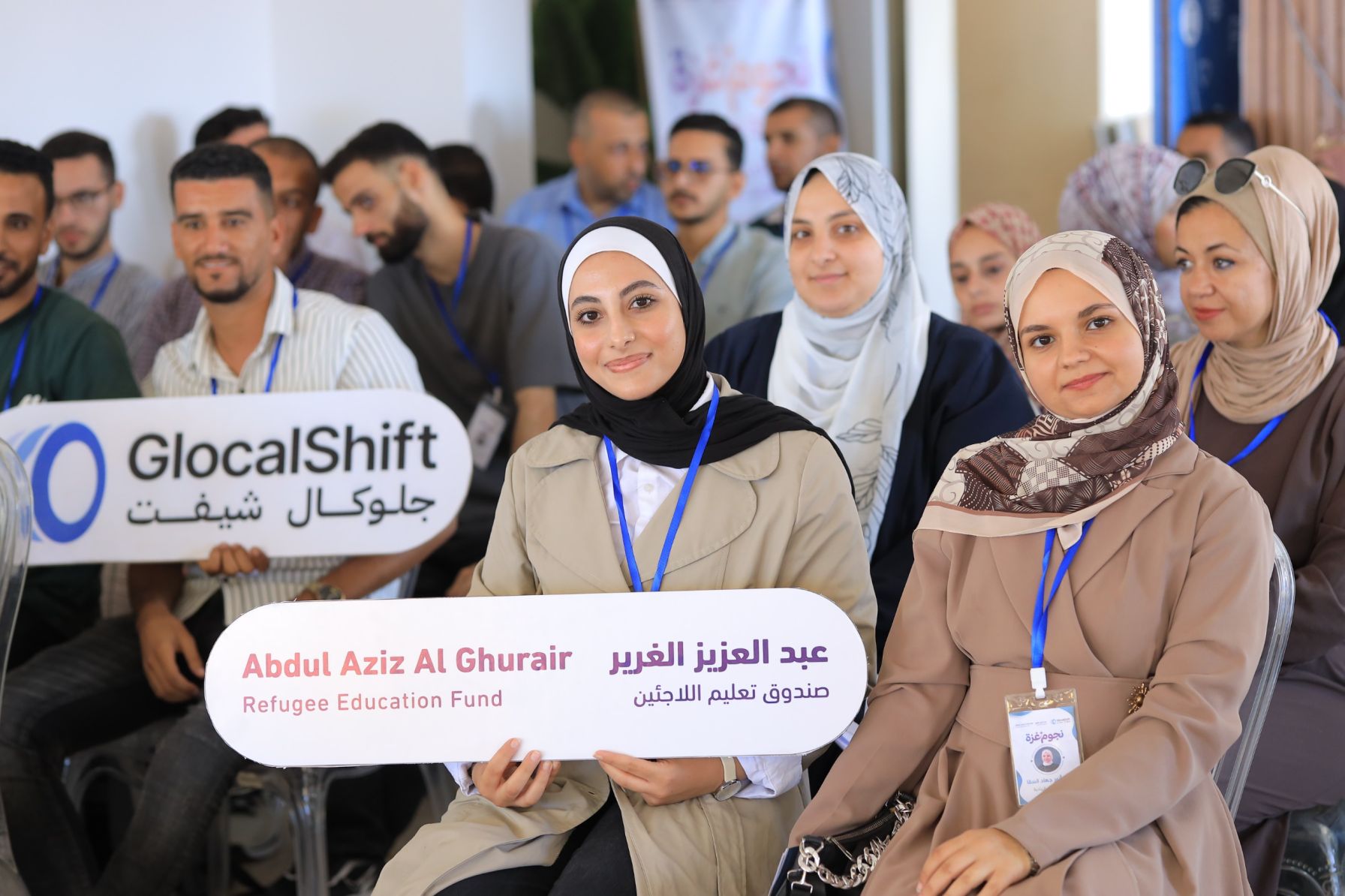
The Return to Rebuild Scholarship, administered by GlocalShift Foundation and funded by the Arab Fund for Economic and Social Development, was set up specifically for students in Mohammad's position. Palestinian medical students in Egypt who were close to finishing their degrees but at serious risk of being forced to stop.
For Mohammad, the support arrived at the exact moment his momentum was beginning to falter. It covered his immediate costs, but what it also did, and this is something he is clear about, was change the internal pressure he was living under every day.
"It eased the financial burden on my family and allowed me to focus entirely on my studies without constant stress," he says. "It gave me stability, hope, and the opportunity to continue."
He draws a distinction between the money and what the money represented.
"Beyond financial assistance, this support represents hope, trust, and belief in my potential," he says. "It gave me emotional strength and reassurance that I am not alone in my journey."
That reassurance is not a small thing. Research on students from conflict-affected backgrounds consistently shows that the sense of being unsupported, of carrying a crisis that the people around you cannot see, is one of the heaviest burdens a student can face. Knowing that an institution had looked at his record, understood his situation, and chosen to invest in his future gave Mohammad something that money alone cannot buy.
The Final Stretch
Mohammad is now in the second and final year of his internship, rotating through clinical departments, building the practical experience that will define the kind of doctor he becomes. He is, in his own words, at a very serious and important moment.
His sights are set on neurosurgery. It is one of the most technically demanding fields in medicine, requiring years of further training beyond graduation. It is also one of the most urgently needed specialisations in any future recovery effort. The war has left behind thousands of patients with severe head and spinal injuries, and the demand for that kind of care will not disappear quickly.
When asked what he wants to do with his training, he does not reach for grand statements.
"I hope to contribute to my community by providing high-quality medical care and serving those who lack access to proper healthcare," he says. "I also hope to mentor younger students and give back to the community that supported me throughout my journey."
It sounds, on the surface, like the kind of thing anyone might say. But for someone who left one degree to start another, who kept working through financial collapse and family displacement, and who is now weeks or months from completing one of the longest and most demanding paths a person can take, it reads differently. It reads like a plan from someone who knows exactly what it costs to follow through.
One of Many
Mohammad is one of 106 Palestinian medical students currently supported by the Return to Rebuild Scholarship. Each of them represents years of prior study, family investment, and a skill set that Gaza will need when rebuilding begins in earnest.
When that moment comes, much of the attention will go to the physical reconstruction, the hospitals that need to be rebuilt, the equipment that needs to be replaced, the infrastructure that has been destroyed. But the harder thing to rebuild is the human capacity to run those facilities. The doctors, the specialists, the people who know how to make a health system work. That takes years to produce and very little time to lose.
Mohammad Al-Jadili has already proven that he can rebuild his own life from the ground up. He did it once when he walked away from nursing to start again. He is almost at the finish line now, and when he gets there, he intends to put everything he has learned to use.
Gaza will need people like him. He already knows it. That is precisely why he never stopped.
%20(2).png)
.jpeg)

%20-%20frame%20at%200m21s.jpg)